

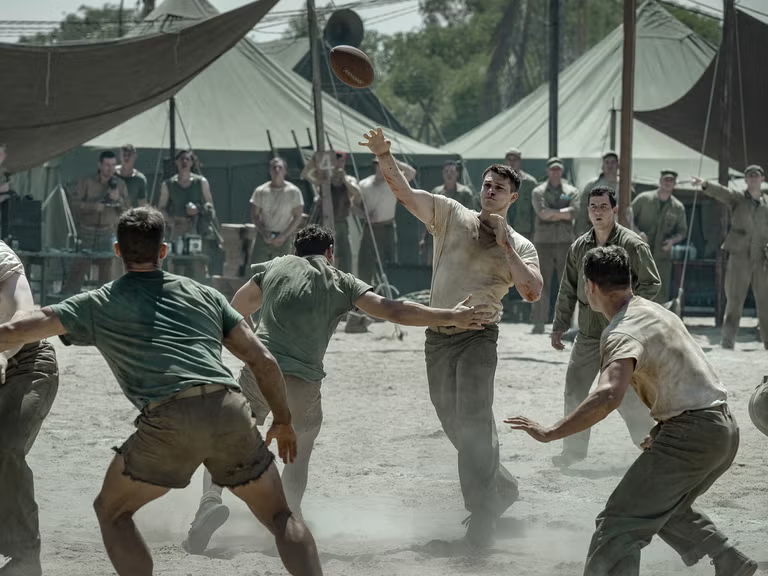

The Mosquito Bowl brings together World War II combat, college football and a cast of rising stars in a Netflix drama inspired by real historical events. Starring Nicholas Galitzine, Bill Skarsgård, Ray Nicholson and Tom Francis, the film explores the experiences of young American football players who joined the Marines during the Second World War.
Although the movie delivers technically impressive battle sequences and ambitious action scenes, its emotional storytelling struggles to match its visual strengths. Despite its promising premise, The Mosquito Bowl often feels more interested in showcasing the scale of war than developing the characters caught in its brutality.
What Is The Mosquito Bowl About?
Directed by Peter Berg, The Mosquito Bowl is adapted from Buzz Bissinger’s book of the same name. The story centers on a football game played by Marines stationed in the Pacific during World War II, bringing together two seemingly different worlds: the competitive spirit of college football and the devastating reality of military combat.
The film opens with a quotation attributed to former US President Herbert Hoover about the devastating consequences of war for younger generations. The statement establishes the central theme of the story: while political leaders may decide to wage war, it is often young people who bear its greatest costs.
However, this familiar anti-war message does little to distinguish the movie from other military dramas. While the premise offers an opportunity to explore the relationship between sport, brotherhood and survival, the execution rarely moves beyond familiar war-film conventions.
The Mosquito Bowl Cast and Characters
The movie features four college football players whose lives change after the Japanese attack on Pearl Harbor in 1941 prompts America’s entry into World War II.
Nicholas Galitzine plays John McLaughry, a Brown University alumnus portrayed as a thoughtful young man navigating the demands of military life.
Ray Nicholson appears as Tony Butkovich, a Purdue University football player whose athletic prospects had placed him on a promising path toward professional football.
Tom Francis and Bill Skarsgård play David Schreiner and Bob Bauman, two University of Wisconsin graduates with contrasting personalities. David carries resentment toward Tony following a significant football defeat, while Bob is presented as a more unpredictable and aggressive character.
The cast brings considerable talent to the production, but the screenplay gives its characters limited opportunities to develop beyond their initial descriptions. Much of their personalities and relationships emerge through brief conversations between military sequences rather than through sustained character development.
Impressive World War II Combat Sequences
One of the strongest aspects of The Mosquito Bowl is its technical approach to depicting warfare.
Filmed in Australia and set in the Pacific theatre of World War II, the movie presents large-scale combat involving soldiers moving through dense vegetation, gunfire, smoke and sudden explosions.
Berg and cinematographer Jacques Jouffret frequently place viewers close to the action. Rather than offering a consistently clear overview of the battlefield, the camera emphasizes the confusion and terror experienced by the soldiers themselves.
Characters struggle to understand what is happening around them, while gunfire erupts from unseen positions and fellow Marines are suddenly struck down. The uncertainty reinforces the frightening reality of combat, where danger can emerge without warning.
These sequences demonstrate the filmmakers’ ability to create convincing and immersive action. The production’s muted colour palette, however, sometimes leans too heavily on the familiar visual style of gritty military dramas.
Although the battle scenes are technically accomplished, their extended duration occasionally comes at the expense of the story. The film repeatedly returns to elaborate action set pieces without providing enough meaningful character development to make their consequences resonate emotionally.
How Football Connects to the Story of War
The central football premise offers the film an opportunity to distinguish itself from conventional World War II dramas.
Football represents competition, ambition and the hopes these young men held before entering military service. War, by contrast, threatens their physical safety, psychological well-being and expectations for the future.
The film occasionally compares military organization with football strategy, showing how the discipline and teamwork players need on the field also help soldiers in the armed forces.
Yet the football game itself receives surprisingly little emphasis considering its importance to the title and premise.
The narrative moves rapidly between training, combat and the preparations for the match. As a result, the game lacks some of the buildup that could have made it a more satisfying emotional and dramatic centerpiece.
The relationship between sport and warfare is an interesting foundation, but the film does not explore it as deeply as it could.
A War Drama That Struggles With Character Development
Despite its strong production values, The Mosquito Bowl frequently struggles to establish an emotional connection between its audience and its characters.
Important developments sometimes occur between scenes, leaving viewers to infer how relationships have changed or how individual Marines have been affected by their experiences.
The screenplay, written by Berg and Mark L. Smith, moves quickly from one major sequence to another. While this approach maintains momentum, it also leaves little room for quieter moments that could reveal the characters’ fears, doubts and personal transformations.
The result is a film in which the events themselves often feel more developed than the people experiencing them.
A more patient narrative could have explored the contrast between the young men’s ambitions before the war and the psychological burden of military service. It could also have given greater attention to the ways their different backgrounds and personalities shape their responses to violence.
Instead, several of the film’s most important themes are communicated through broad statements about brotherhood, sacrifice and the destruction caused by war.
The Mosquito Bowl Explores the Cost of Military Service
At its core, The Mosquito Bowl presents military service as an experience that transforms young men while exposing them to profound physical and psychological suffering.
The film acknowledges some of the harsher attitudes associated with wartime culture, including the eagerness of certain characters to fight and kill their enemies. However, it rarely examines these attitudes in sufficient depth.
This creates a tension between the film’s apparent desire to portray the realities of war and its tendency to frame military service through familiar ideas of heroism and self-sacrifice.
The story occasionally pauses to offer broader reflections on humanity and the scale of suffering. Images of devastated landscapes and quiet moments amid the violence encourage viewers to consider the consequences of conflict beyond the immediate experiences of the main characters.
These moments suggest a more thoughtful film beneath the surface. Unfortunately, the broader narrative does not consistently develop the questions they raise.
Final Verdict: Is The Mosquito Bowl Worth Watching?
The Mosquito Bowl has several strengths, particularly its large-scale combat sequences, technical craftsmanship and capable cast. Peter Berg demonstrates considerable skill in staging chaotic battlefield scenes, while the historical football premise provides an interesting foundation for a World War II drama.
However, the film’s storytelling does not fully capitalize on these advantages. Underdeveloped characters, rushed transitions and limited emotional exploration weaken the impact of its central themes.
For viewers who enjoy military action and visually ambitious war films, the production may still offer an engaging experience. Those looking for a deeply developed character drama or a fresh examination of the psychological consequences of war may find it less satisfying.
Ultimately, The Mosquito Bowl is a technically impressive but emotionally underwhelming war drama. Its premise promises a compelling intersection of football, friendship and military history, but the finished film struggles to turn that promise into a consistently powerful story.